
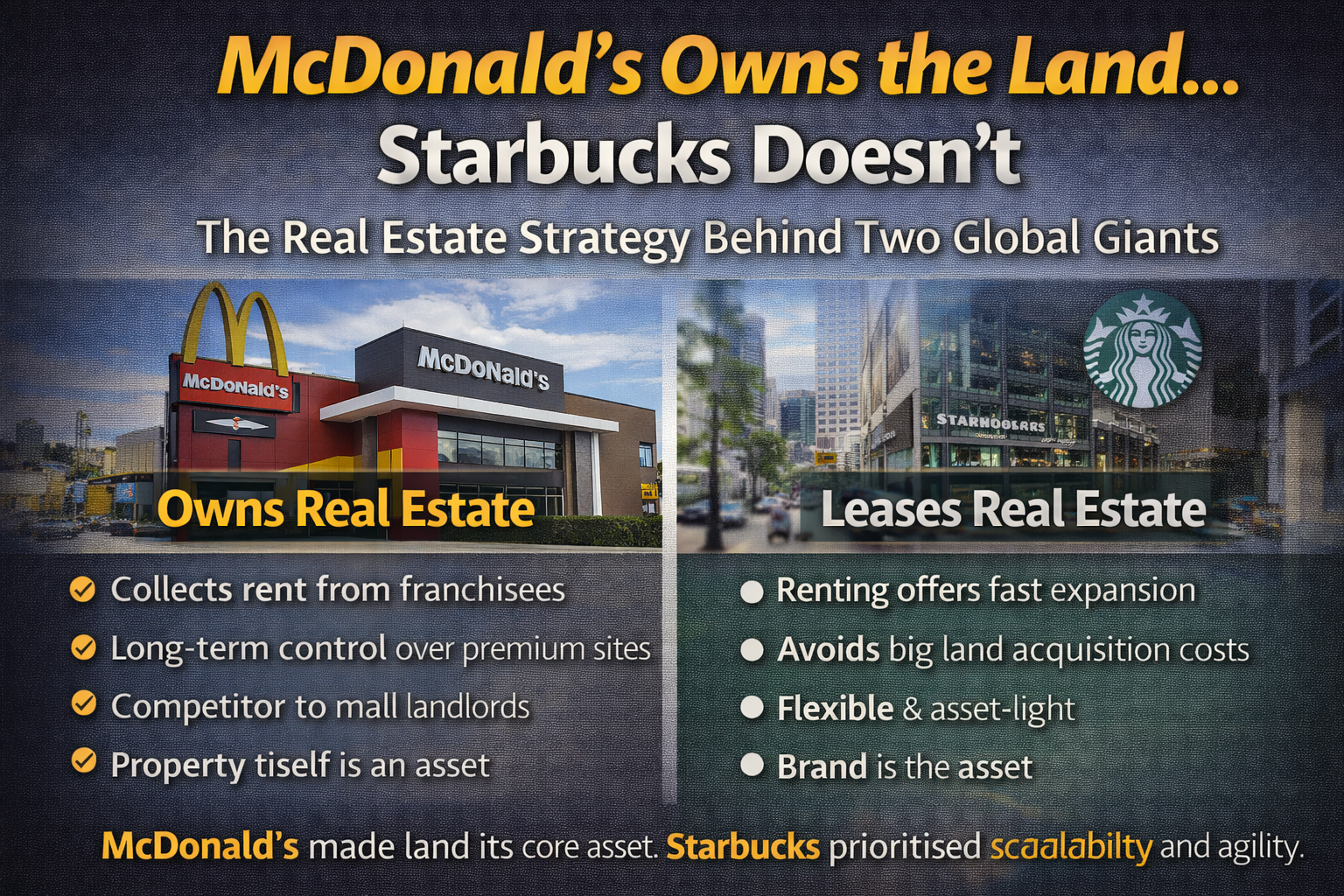
PHOTO: 🌍 Two Global Brands. Two Completely Different Property Plays. PROPERTY NOISE
At first glance, McDonald’s and Starbucks appear to be competing in the same space: food, convenience, and scale.
But behind the counter lies a fundamental strategic difference that has shaped each company’s long-term success:
👉 McDonald’s is a real estate business disguised as a restaurant chain.
👉 Starbucks is a brand-driven retailer that treats property as flexible infrastructure.
Understanding why one owns land — and the other mostly doesn’t — reveals a masterclass in capital allocation and growth strategy.
🔑 McDonald’s: Built on Property, Not Burgers
McDonald’s began prioritising real estate ownership in the 1950s under the guidance of early executives who recognised one thing early:
📌 Land lasts longer than menu items.
Rather than simply franchising restaurants, McDonald’s systematically:
-
Acquired prime land parcels
-
Built restaurants on them
-
Leased those sites back to franchisees
🏗 Why This Model Works
-
Franchisees pay rent + royalties
-
Rent is due regardless of burger sales
-
Property appreciates over time
-
McDonald’s controls location, redevelopment, and resale
Today, McDonald’s owns or controls a substantial portion of the land beneath its global footprint — particularly in high-traffic intersections, arterial roads, and suburban hubs.
This creates:
-
Stable, predictable cashflow
-
Inflation protection
-
Balance-sheet strength
-
Long-term asset appreciation
Many analysts argue McDonald’s would remain highly profitable even if food margins fell, because the property engine keeps running.
☕ Starbucks: Speed, Flexibility, and Brand Over Bricks
Starbucks chose a completely different path.
Rather than tying up billions in land ownership, Starbucks operates an asset-light, lease-based model, prioritising presence over permanence.
Starbucks typically:
-
Leases space in high-foot-traffic areas
-
Focuses on visibility, convenience, and clustering
-
Opens, relocates, or closes stores quickly
-
Invests capital into brand, technology, and customer experience
📍 Why Starbucks Avoids Owning Most Real Estate
-
Faster global expansion
-
Lower upfront capital requirements
-
Ability to adapt to changing consumer behaviour
-
Reduced exposure to property market cycles
For Starbucks, the brand is the asset, not the land.
Its competitive advantage comes from:
-
Density of stores
-
Customer habit formation
-
Consistency of experience
-
Prime leasing locations — without long-term ownership risk
📊 Two Strategies, Two Outcomes
| McDonald’s | Starbucks |
|---|---|
| Owns or controls land | Mostly leases |
| Earns rent + food revenue | Earns retail margins |
| Slower but durable expansion | Faster, flexible rollout |
| Strong property balance sheet | Asset-light structure |
| Franchise-led | Operator-led |
Neither approach is “better” — they are simply optimised for different goals.
🧠 Why McDonald’s Could Do This (and Starbucks Didn’t)
McDonald’s model works because:
-
Drive-throughs require large land parcels
-
Locations are long-term, not trend-based
-
Franchisees shoulder operating risk
-
Property creates leverage over franchise performance
Starbucks’ model works because:
-
Coffee consumption is habit-driven and urban
-
Foot traffic shifts over time
-
Smaller store footprints allow flexibility
-
Brand equity is the primary moat
Owning land would slow Starbucks down — while leasing would weaken McDonald’s control.
🏠 Lessons for Property Investors & Business Owners
This comparison highlights a powerful truth:
📌 Real estate strategy must match the business model.
-
Long-term, location-dependent businesses benefit from ownership
-
Trend-driven, experience-based brands benefit from flexibility
-
Property can be a profit centre — or simply a platform
McDonald’s monetises land scarcity.
Starbucks monetises consumer behaviour.
Both win — just in very different ways.