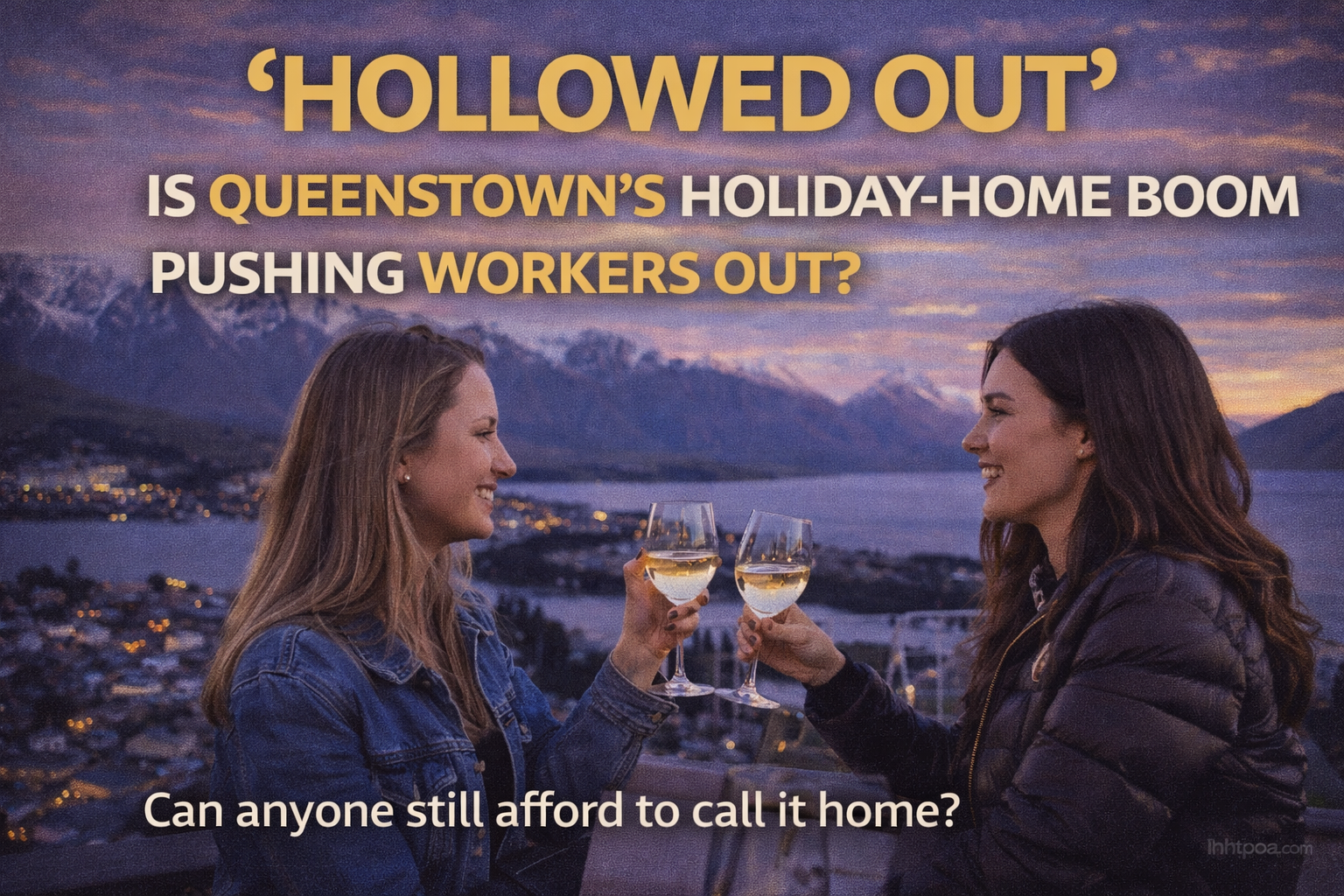
PHOTO: Empty Houses, Soaring Rents and a Town at Risk of Losing Its Soul. PROPERTY NOISE
Queenstown is one of New Zealand’s most globally recognised destinations — but behind the postcard views and booming tourism economy, a quieter crisis is unfolding.
According to a former senior economist from the World Bank, the rapid growth of holiday homes left empty for much of the year is putting Queenstown on track to be “hollowed out” — unless urgent action is taken to deliver affordable housing for workers.
The warning is stark: a town full of houses, but short of people who can actually live there.
📉 The Numbers Tell a Concerning Story
Recent data paints a picture of a housing market increasingly detached from the people who keep the district running.
At any given time, more than a quarter of properties in the Queenstown Lakes District are unoccupied.
On Census night 2023:
-
3,480 dwellings were completely empty
-
3,402 were recorded as ‘residents away’
-
18,219 properties were occupied or under construction
In effect, thousands of homes existed — but not as places of permanent residence.
For a town heavily reliant on hospitality, tourism, construction, healthcare and service workers, this imbalance is becoming economically and socially destabilising.
🏡 Holiday Homes vs Permanent Communities
Holiday homes and investment properties have long been part of Queenstown’s appeal. For overseas buyers, high-net-worth New Zealanders and lifestyle investors, the region represents:
-
capital preservation
-
lifestyle optionality
-
prestige ownership
-
short-term accommodation returns
But when too many homes sit dark for most of the year, the town loses something fundamental: a permanent population.
Schools struggle to retain families.
Businesses can’t staff year-round roles.
Community organisations shrink.
Local culture erodes.
This is what economists refer to as “hollowing out” — where places retain buildings but lose their living communities.
💸 Housing Costs Keep Rising — Workers Can’t Keep Up
At the same time as occupancy rates fall, housing costs have surged.
-
Rents have risen sharply
-
House prices have climbed well beyond local wage growth
-
Essential workers are being forced to commute long distances or leave the district entirely
More than 1,600 households are now on a waitlist for an affordable housing scheme, highlighting how far demand has outpaced supply at the lower and middle end of the market.
This isn’t a fringe issue — it’s affecting:
-
hospitality staff
-
teachers
-
nurses
-
tradespeople
-
retail workers
-
emergency services
In short, the people who make Queenstown function.
🧠 Why Market Forces Alone Aren’t Fixing This
In theory, high prices should encourage more building. In practice, several barriers remain:
-
land constraints and planning complexity
-
high construction costs
-
developer focus on premium product
-
limited incentives for long-term worker housing
Left to itself, the market tends to deliver what is most profitable, not what is most socially necessary.
That’s why the former World Bank economist argues stronger intervention is required — not just incremental tweaks.
🏗️ What “Strong Action” Could Actually Look Like
Policy options increasingly being discussed include:
-
large-scale, purpose-built affordable housing
-
worker-only or long-term rental covenants
-
tighter controls on vacant dwellings
-
incentives or requirements tied to new developments
-
restrictions on non-resident or speculative ownership
Each option is politically sensitive — but the alternative is a town that slowly becomes a seasonal resort rather than a functioning community.
⚠️ The Risk of Doing Nothing
If current trends continue:
-
businesses will struggle to operate year-round
-
labour shortages will worsen
-
infrastructure costs will rise for fewer permanent residents
-
community cohesion will weaken
Ironically, the very lifestyle and vibrancy that attract holiday-home buyers could be undermined by the absence of full-time locals.
🧭 A Warning With National Implications
While Queenstown sits at the extreme end of the spectrum, it is not alone.
Similar pressures are emerging in:
-
Wanaka
-
parts of Central Otago
-
coastal lifestyle towns
-
high-amenity tourism regions
Queenstown may simply be the canary in the coal mine for what happens when housing becomes primarily a financial asset rather than a place to live.
🏁 The Bottom Line
Queenstown does not have a housing shortage in the traditional sense — it has a housing-use problem.
Thousands of properties exist.
Too few are lived in permanently.
Without decisive action, the town risks becoming a place people visit — but fewer can afford to call home.